In and Out on mobile: an expanding grid on a small screen
Most pages about a slot on a phone say the same thing — it works, it is responsive, enjoy. That is true here and it is also the least interesting thing about it. This game asks more of a small screen than almost any other kind of slot, because the board does not stay the same size for the length of a round.
What follows is the practical side: what a phone handles easily, what it handles badly, and what is worth doing about it.
A browser game, and nothing to install
The title runs in a mobile browser at whichever operator hosts it. There is nothing to
download, no store listing, and no installer. That is worth saying flatly, because the
names of popular slots are routinely attached to packaged files that have nothing to do with
the studio that made them, and a file promising this game is not coming from the people who
built it.
In practice it means the phone experience is decided by two things only: the operator's own
wrapper around the game, and the size of the screen. The game itself is the same build on a
handset as on a desktop.
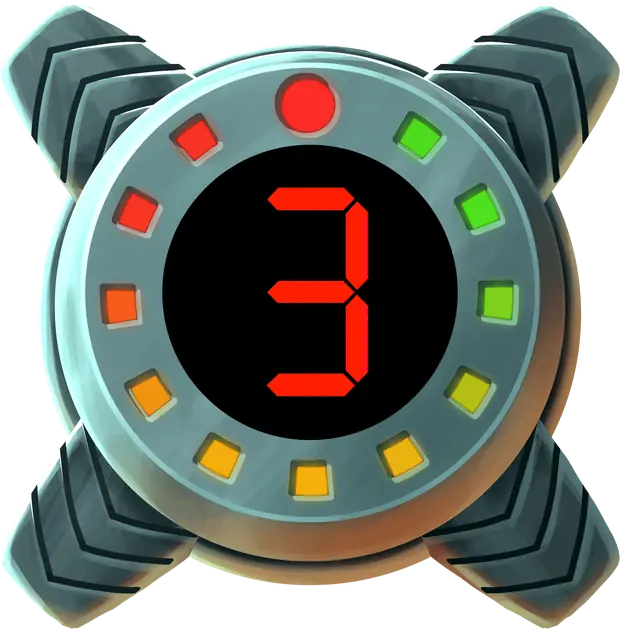
Counters like this one are the first thing that gets hard to read when the board grows.
What a board that changes size does to a small screen
A round opens at 6x5 — thirty positions, comfortable on any phone held either
way. By the end of a round with bombs in it there can be 8x7: fifty-six positions,
very nearly twice as many, in the same physical space. The board does not scroll and it does
not reflow into a different shape. The symbols simply get smaller.
Held in portrait, eight positions across a phone screen leaves each one roughly the width of
a fingertip, and the tier colours — which are the main thing worth watching — become a thin
frame rather than an obvious border. Turned to landscape the same board has the full width of
the handset to work with and the difference is immediate. For this game, landscape is not a
preference; it is the orientation the expanded board was designed to be legible in.
The two moments that are hardest to follow on a handset
The first is a long chain. Each stage clears symbols, refills, and re-marks positions, and on
a phone those three things happen quickly in a small space. It is entirely possible to watch
a four-stage chain and not be able to say afterwards which positions were lifted and when.
Nothing is lost by that — the game keeps its own record and the marks stay visible — but the
sense of following what is happening does go.
The second is the collection round. Positions spin independently, values land and stay, and
specials change the tier of things around them. On a desktop the board reads as a board. On a
phone it reads as a lot of small bright things arriving at once, and the moment the area has
been expanded by a Burst it is harder again. The total at the end is the same; the ability to
see how it was arrived at is not.
Both of these are about legibility, not fairness. Nothing about a round changes with the size
of the screen, and a player who could not follow a chain has not missed anything the game
will later ask them about.
Trying it for nothing first, and what that is actually good for
Where an operator or the studio's own library carries a demo, it runs in a mobile browser in
exactly the way the paid version does. There is no demo on this site and no game of any kind
runs here.
A free round on a phone is unusually worth the time for this particular title, and for a
narrow reason: it is the cheapest way to find out whether the expanded board is legible on
your own handset. Screen sizes vary enough that this genuinely differs from phone to phone,
and the answer takes one round with bombs in it to establish. What a free round cannot do is
teach anything about how the game behaves with money on it, because the only thing that
changes is the player.
Playing on a phone without losing track of the session
A phone is where most sessions on games like this one happen, and it is also where a session
is hardest to keep hold of. A cascading round takes longer than a flat one, the screen is in
the hand rather than on a desk, and there is no natural stopping point built into any of it.
The practical defences are dull and they work: decide the length of the session before
starting it rather than the number of spins, use the deposit and time limits the operator is
obliged to offer, and treat a stake as the price of the entertainment rather than as money
that is coming back. Nothing in this game, or any game of its kind, is designed to be beaten
by attention.
Phones, orientation and whether anything needs installing
These four answers are carried word for word in the page's structured data.
Is there an In and Out slot app, or only mobile browser play?
No. The game runs in a mobile browser at the operator that hosts it. Any packaged installer carrying the title's name did not come from the studio.
Does the grid still grow on a phone?
Yes. The same 6x5 board and the same ceiling of 8x7 apply; the symbols get smaller rather than the board getting shorter.
Should the In and Out slot be played in portrait or landscape?
Landscape once the board has grown. A row of eight positions across a portrait screen leaves each one about a finger wide.
Can the game be tried for free on a phone?
Where an operator or the studio's own library offers a demo, it runs in a mobile browser like the paid version. There is no demo on this site.